The Nightmare Before Christmas

This thing is going to haunt my dreams tonight:

Da-dunk. Da-dunk. Da-dunk.

Riding up and over every rail joint like it was a cliff edge.

Da-dunk. Da-dunk. Da-dunk.

Shuddering round every corner as if it were a counter-cambered right-angle.

Da-dunk. Da-dunk. Da-dunk.

Actually being colder inside than it is outside.

Da-dunk. Da-dunk. Da-dunk.

Relentless.

Da-Dunk. Da-Dunk. Da-Dunk.

Never-ending.

Da-DUNK. Da-DUNK. Da-DUNK.


Oh boy, this is going to take some therapy.

Standard

Pacing Yourself

Thanks to the wonders of the internet, I’ve found out that the illegitimate train/bus love-child that I’ve spent the last three hours, twenty minutes on is actually called a ‘Pacer’, and, shockingly, there is more than one of them! In something of a massive coincidence I happened upon a piece of slightly yellowing paper blowing around on Barrow station. When I glanced at the type-written heading at the top of the page I knew instantly that it was something I had to reproduce here:

Minutes of the First Meeting of The BR Surplus Bus Parts Committee (SUBPAC), December 16th, 1982

The meeting was called to order. The Chair reported that he’d received apologies from. Mr Wainwright (Chief of BR Procurement – COBROC), who unfortunately was still feeling unwell following the previous week’s staff Christmas party. The Chair noted this led on nicely to the purpose of this inaugural meeting of the committee, which was to decide what to do with the sudden, and unexpected, large surplus of bus parts that BR had suddenly found itself in receipt of.
Mr Bletchley (Chief of BR New Fleet Introductions – COBFIN) took the floor and read out a letter he had received the previous day from the aforementioned Mr Wainwright (COBROC). In the letter, Mr Wainwright (COBROC) stated that, with hindsight, it had probably been a bad idea for him to go back into the office after the Christmas party and continue with the procurement of the rail replacement bus fleet. He expressed his dismay at what had happened but reminded the committee that, after eight pints, ten busses easily became a hundred. It was just another zero.
Mr Bletchley (COBFIN) remarked that, while these circumstances were undesirable, the Surplus Bus Parts Committee (SUBPAC) had to make the most of the opportunity. The Chair agreed, and tabled the suggestion that a sub-committee, or working group, be set up to decide the best way of exploiting the procured surplus bus parts. He proposed this be called the Surplus Bus Parts Committee Sub Group on the Exploitation of the Surplus Bus Parts (SUBPAC-SUBG-EXPSUBP). Mr Bletchley (COBFIN) questioned whether the proposed role of the SUBPAC-SUBG-EXPSUBP was, in fact, within the remit of, or indeed the sole purpose of, the newly formed SUBPAC committee, of which this was the inaugural meeting.
There followed much debate, after which it was decided to break for lunch.

**Post Meeting Note: Lunch continued for several hours, during which large amounts of alcohol were consumed by both Mr. Bletchley (COBFIN) and The Chair. Mr Bletchley (COBFIN) proposed that, rather then continue the meeting, they just get the work-experience placement kid (WEXKID) to figure out how to make a train out the the surplus bus parts. The chair agreed, with the proviso that any such train would have to forgo things such as heaters, toilets, doors, springs, waterproofing and lights as these would be too difficult for the work experience kid (WEXKID (or Stu, to his mates)) to include. Mr Bletchley (COBFIN) agreed, stating that whatever design WEXKID came up with would only be a temporary solution. There being no further business the chair declared the meeting closed and moved the working lunch to The Dog and Duck.**


So there you have it. It all makes sense now…

Standard

The Zero Theorem

In order to make my travel plans today work I had to achieve what (from now on) will be known as a ‘zero minute connection’. The problem was this: My train from Newcastle to Carlisle was booked to arrive in Carlisle at 12:47pm; my train from Carlisle down the coast to Barrow was booked to depart at 12:47pm.

Now any rational person would have decided that this was not a reasonable connection to attempt, especially given that there was a two-hour wait to the next train, but this is me you’re talking about. I decided that this connection was worth a shot because a) There’s always float in the timetable for inbound trains before they reach their final destination – saves the train companies having to pay out for delays; b) The inbound service for the Barrow train had a very quick turn around at Carlisle to keep to; c) Carlisle isn’t New Street, it won’t be that far from one platform to the other.
Unfortunately the internet age turned this into a nail-biter. With the help of the National Rail app I was able to track the inbound service from Barrow up the coast, becoming more and more elated as it slipped to being delayed by almost eight minutes. My service from Newcastle was flying along, arriving early at all the intermediate stops. This was in the bag.

Then calamity struck! Against all expectations the two-car bus/train hybrid thingy coming in-bound from Barrow started to make up time! Suddenly it was only six minutes late, then four, then three. I started looking at the options for a plan b.

Now I haven’t travelled into Carlisle much, so I don’t know what the surrounding area looks like and hence couldn’t judge how much time there was left to go in the journey. When my phone told me that the inbound Barrow service had done-the-impossible and arrived on time I assumed it was game over. With half the World tracking my progress on Facebook today this would require some explaining…

But then we were there! Suddenly the green fields gave way to station concourse and we’d arrived! I looked at my watch: 12:45:54. There was time yet! I flew out of the train like a bullet from a gun and, in a very un-elegant style, ran up, over the footbridge, and down the full length of the opposing platform to where my bus/train abomination that was headed for Barrow was shuddering away to itself. I got on, sat down, the doors closed and it left on time.

I relaxed into my bus-style seat and looked at the other passengers unfortunate enough to be on this ‘train’. I looked further around the carriage. “That’s interesting” I thought: “no toilet”. My mild panic at this development was soon abated when I realised that there was no refreshment trolley either. The twisted logic kind of made sense…if you don’t have the trolley people won’t drink; if they don’t drink, you can do away with the toilet!

It was going to be a long three-hours…

Standard

Edinburgh

I’d heard many things about Edinburgh as a city, some complimentary, some not. I think the main discerning factor was what the weather was doing when the people in question visited. (I have a similar thing going on with Oxford and Cambridge – the two times I’ve visited Oxford it’s been gloriously sunny, the two times I’ve visited Cambridge it’s been throwing it down with rain. Hence, shallow though it may be, I have a much better opinion of Oxford than of Cambridge.)
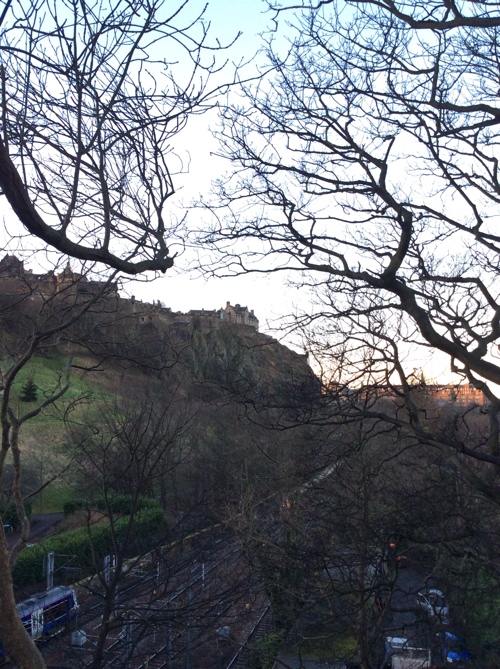
As it was, for my brief wander round I was blessed with clear blue skies and a crisp, but not cold, morning. The city certainly has an impact on you. The numerous historic buildings, monuments and vistas are coupled with a ‘buzz’ that few cities in the UK have. It also feels immediately welcoming and friendly – this might have something to do with the Christmas markets on every corner but I don’t think so.
Edinburgh Waverley station itself sits proudly in the middle of the city, with a design and platform layout that gives the impression that it has been organically grown rather than planned. The trains seem to enter the station from all angles, and some platforms sit completely out of sequence with the rest of them. Don’t get me wrong, this isn’t a bad thing, it just adds a bit of spice to he usual, ordered, convention for platform numbering that seems to have been adopted by the rest of the country (exceptions welcome).
When you exit the station you are immediately struck by two things: 1. The various awe-inspiring gothic (?) buildings and castles that dot the cityscape and 2. One heck of a cross-wind. Immediately after arriving I tried to head straight for my hotel, on Cowgate, to rid myself of the large rucksack that I’d been wearing any time I walked anywhere for the past two days. (An example of how much this had been weighing on my mind as well as my body was that I’d come up with an entirely new set of lyrics for the Frozen song ‘for the first time in forever’ on the way down from Inverness – all relating to getting shot of the rucksack.)
I was slightly caught out by the ‘google maps’ representation of the city, which doesn’t, unless you really squint at it, let on that some roads are a good ten metres higher than others. According to google, I just had to turn left at a crossroads to get onto the road where my hotel was. Unfortunately the crossroads was a bridge, and, although I could see the hotel, I couldn’t get there without a parachute. Luckily there was a secret staircase that craftily cut down between the stone buildings and deposited me opposite to the hotel entrance.
I say ‘secret’ but, in fact, these staircases are everywhere in Edinburgh. As I walked round the city it rapidly became apparent that the entire place was set up as a giant game of snakes-and-ladders. I’d walk for five minutes up a long, zig-zaggy road, only to get to the top and stumble upon a staircase that led directly back to where I started from, cutting a straight line down the hillside with a steep staircase. I think this is great! For people who know the city well it must be possible to get from A to B in a matter of seconds, while your tourist friend will spend thirty minutes doing the same thing. (Similar to the Charing Cross to Covent Garden tube ‘trick’ in London.) These staircases and passageways also gave the city a hint of mystery and old-worldliness. It felt a bit like a giant labyrinth – I was half-expecting David Bowie to be waiting for me with a collection of goblins every time I turned a corner.

Edinburgh is certainly a city that I’ll visit again, and soon. It has a character and charm that is lacking, in my opinion, in many of the cities in the midlands that are slowly turning into clones of each other. I think I could quite easily spend a week exploring all the twists and turns of the Edinburgh streets, and it looked like there were a couple of good hills to climb too…

Bidding farewell to Edinburgh I boarded an East Coast train, to continue my journey south.


Standard

ScotRail

Things I like about ScotRail:

1. The name. It does what it says on the tin. Nothing more, nothing less. The tag-line for ScotRail is, in fact: “Scotland’s Railway”. This is not amazingly imaginative but, again, functional. If it were “ScotRail: Cornwall’s Railway” – that would be a bit odd.

2. The automated train announcements. They are done in a Scottish accent. This, at first, doesn’t seem odd: it is Scotland after all. But when you start to think about it, nowhere else in the UK does this. Every other train operating company has a clipped, English, automated voice. Maybe we’re all missing out on something? Maybe the automated announcements on Arriva Trains Wales should all be in a ‘valleys’ accent? Maybe the automated voices on the tube should be in cockney, or Souf Laarndan drawl? Maybe every automated announcement on East Midlands Trains should start with ‘all-right ducky?’.
Come on rest-of-the-UK… Scotland’s leading the way on this one!

3. The non-automated train announcements. Example from today: “We’re now arriving at Dunkeld. If you’re alighting here at Dunkeld please be aware of the very large gap between the train and the platform. Really, the platform is very, very low. There are steps available but, even with those, it’s still really, very, very low. I don’t know why…(trails off)”.

4. The free WiFi on all services. COME ON every-other-train-operating-company-in-the-UK. Sort it out! The free WiFi allows your passengers to post blogs as they’re traveling along your lines. Don’t give me any crap about signal problems…this works in the Highlands!

5. The colour scheme. Purple and grey is the new black.


That is all.

Standard

Echoes of Independence


It’s almost three months to the day since Scotland voted to remain part of the United Kingdom and it would be difficult to undertake a tour of Scotland without at least mentioning this in some form. The political contest of late summer was unprecedented in its reach, ferocity and divisiveness. In many areas of Scotland more than ninety percent of people turned out on the 18th September to vote, a figure that had never been seen in a UK election before. There seemed to be a momentum, a belief that maybe this was Scotland’s ‘time’, and this was reflected in the vocal nature of the ‘Yes’ campaign. As it turned out, even this perceived groundswell of support wasn’t enough to topple the status-quo, and on the day the ‘No’ campaign won by almost ten points. (The status-quo is a powerful factor and, in the past, the opposing campaign has had to be leading by at least eight points in the polls going into voting day to have even a slim chance of winning).

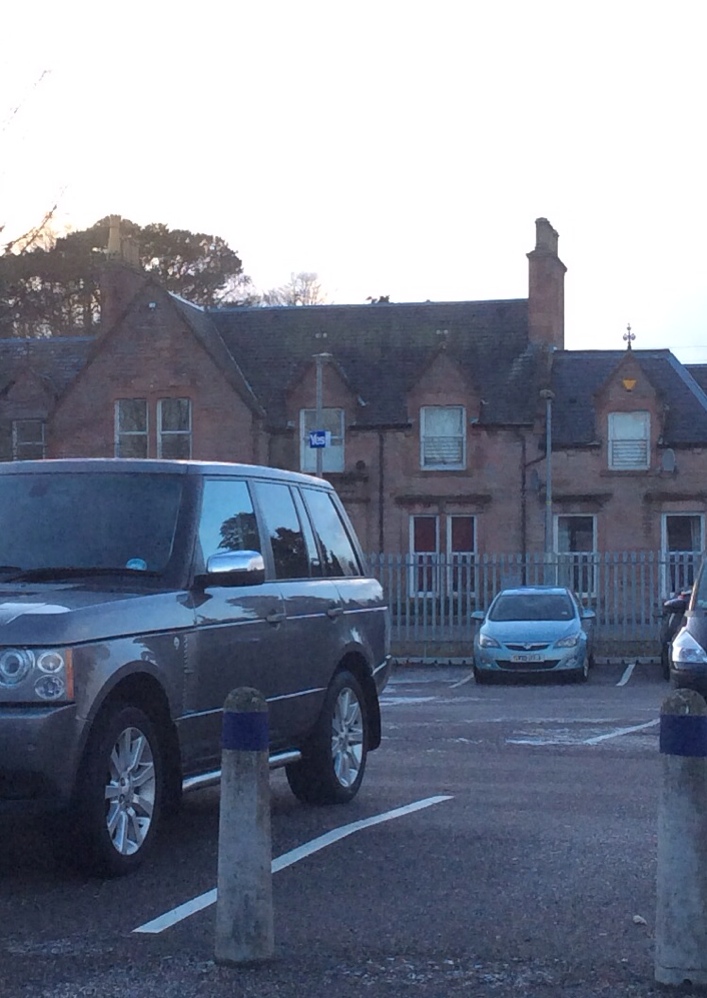
The remains of the independence campaign are everywhere to be seen, even three months on. Travelling along on the train your eye will be caught by a banner in a field, a poster in someone’s window or a placard high up, out of reach, on a lamp post (as shown above). These seem to be almost exclusively ‘Yes’ campaign material, sitting forlornly, waiting for the victory that never was. I wonder if they’ve been left there intentionally, as a reminder to those who voted ‘No’ that the margin wasn’t as large as they might have liked, or is it simply that the energy and enthusiasm that motivated their placement is now gone, evaporated in the early hours of the nineteenth of September? They do seem to be relics of a battle lost, and remind me in a way of the pillboxes and bunkers that dot the landscape in the South East of England – once seen as essential but now redundant, historic, and not worth the effort to remove.
If things had been different, if the ‘Yes’ campaign had won, would the countryside still be dotted with ‘No’ banners providing impromptu shelter to the windswept sheep? I don’t think so. The ‘Yes’ campaign was aspirational, inspirational, and now seems to be developing a romanticism of the ‘lost cause’ around it; in some windows the ‘Yes’ posters have been replaced with ones saying ’45’ (a reference to the share of the vote that the ‘Yes’ campaign got).
In some mid-western and southern states in the US you can find a similar romanticism about the ‘lost cause’ of the Confederate States of America. While people today deplore many of the notions that the confederacy was promoting, they are still attracted by the David-vs-Goliath portrayal of the gallant southern states breaking away from the powerful and over-bearing union. This pride in the fight, and that the cause came so close to being realised, seems to be motivating many ‘Yes’ campaigners to carry on.
So what now for Scottish independence? Like Quebec (and it’s role in Canada), will the fires of separatism slowly die away now that the question has been answered? Or will the memory of the ‘lost cause’ stoke the embers back into another campaign that is ultimately successful?
Walking around Inverness it was interesting to note that the ‘Yes Scotland’ shop had recently reopened. The signs in the window were encouraging people to join (and vote) for the SNP, reminding them that Nicola Sturgeon may well hold the balance of power in Westminster come the next general election; reminding them that any SNP support for a minority Labour government would be dependent on another referendum being held. The letters pages of The Scotsman newspaper today are filled with correspondence about the oil prices and what this would have meant for an independent Scotland. A page in the paper is dedicated to the results of an opinion poll asking ‘how would you vote if the referendum were held again today?’.

It’s clear that the question of whether or not Scotland should be independent still sits close to the surface in many people’s minds here. It is also clear that this is not an issue that is simply going to fade away into the night.

Do I think Scotland will eventually become an independent country? Probably. Do I think this will happen in my lifetime? Almost certainly. The emotion and passion stirred by the ‘Yes’ campaign is still there, and the demographics are in its favour. Be it in fits and starts over the next two decades, or in another all-or-nothing vote, I think Scotland will, ultimately, wrest itself free of the Westminster parliament. It’s just a matter of time.


Standard

From Achanalt to Attadale (and back again)

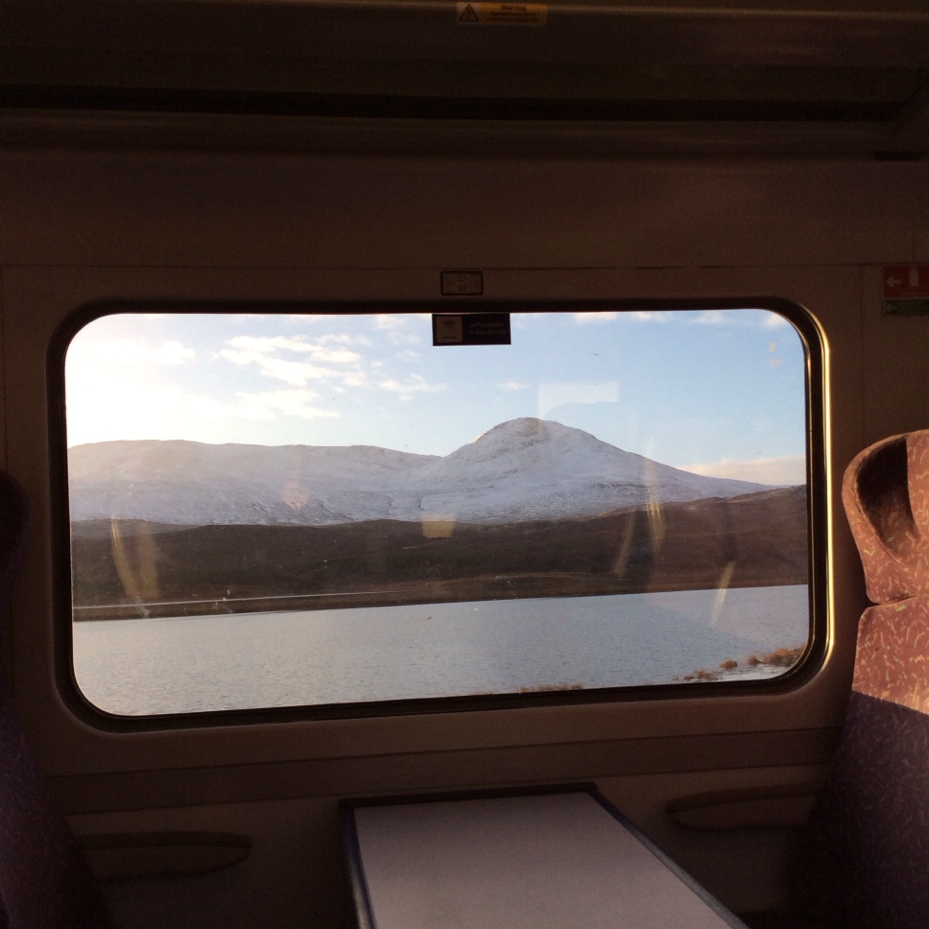
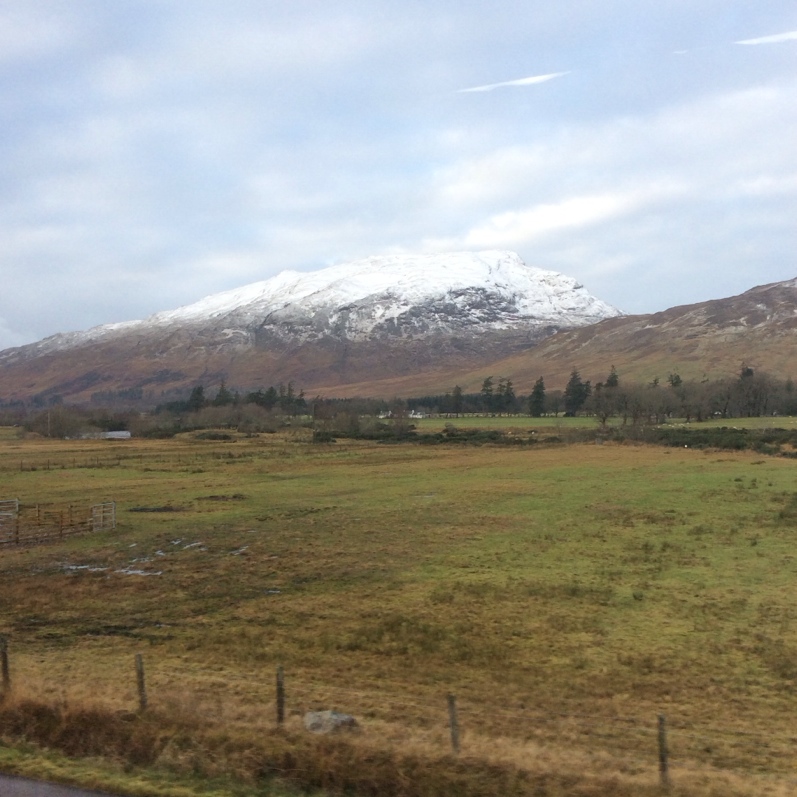
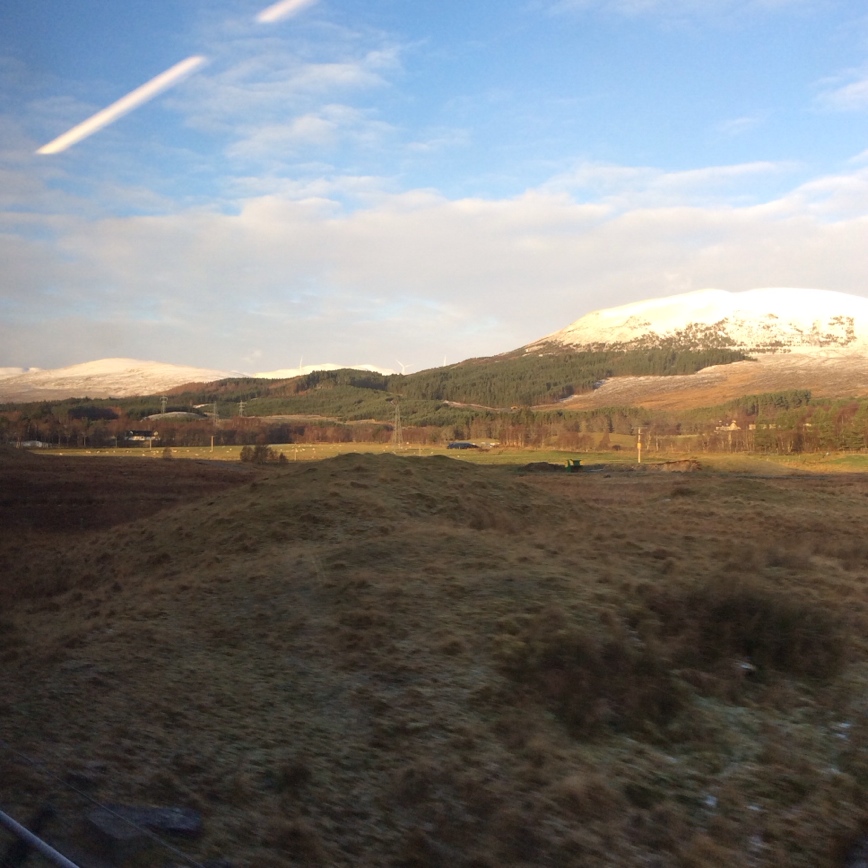
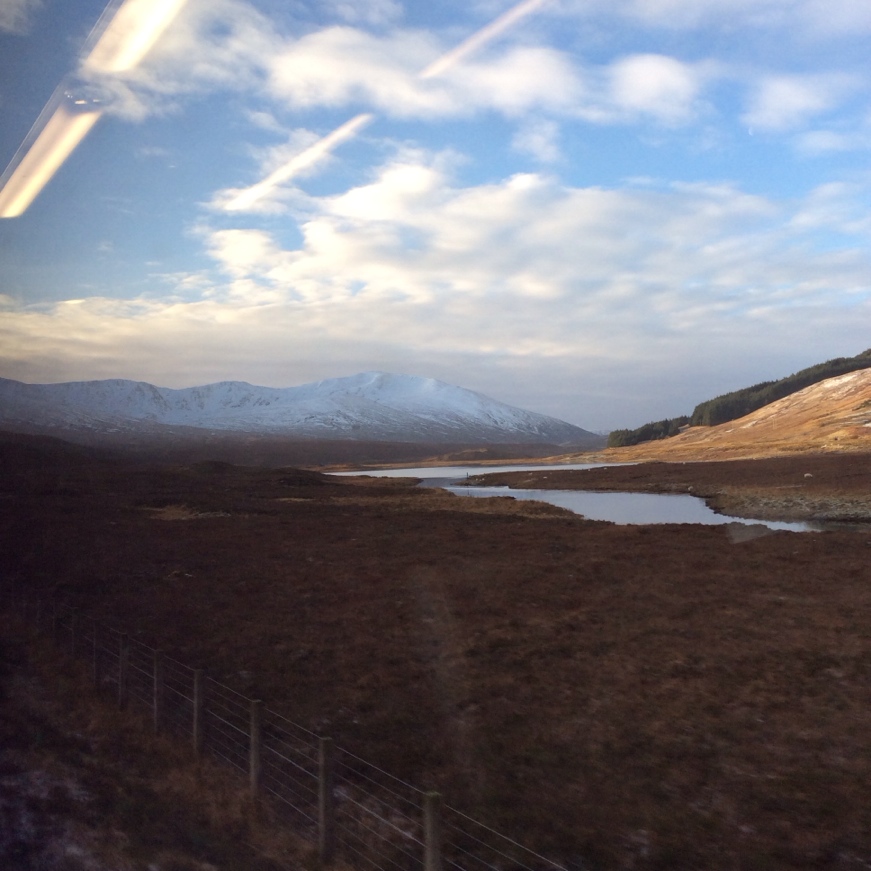
When writing about Inverness earlier I almost said that it reminded me of Canada: the mountains, the forests and the snow. Having now travelled all the way out to Kyle of Lochalsh I think I can now say it’s amazing how much the highlands in winter are like northern Canada, except at a much more friendly scale. When travelling around Canada you see some amazing mountain vistas, lakes and ‘rugged’ scenery. The only problem is the fourteen-hundred miles of forest you have to drive through to get from one lake view to the next. It is possible in Canada to drive for five hours straight through identical scenery – which makes it difficult to know if you’ve progressed at all!
The highlands is the polar opposite of this. You’ve just passed by a breathtaking view of a snow-capped mountain range and you’re suddenly diving down towards a perfectly still loch that’s reflecting the azure blue skies. You’ve only just taken that in and your attention is distracted by a stag wandering across the rolling heathland. Just as you begin to think that this is the first time you’ve seen a stag in the wild your eyes are drawn to a picture-perfect finishing village situated adjacent to where a roaring stream enters the loch.
I’ve heard people wax lyrical in the past about what a remarkable place the Scottish highlands are, and I think I’m now starting to get an idea of where they’re coming from. This area’s definitely going on the ‘future holiday’ list, although maybe at a time of year when the wind isn’t quite as biting as it is today.
That said, I think visiting this area just as winter proper starts may have been quite a good idea; you get the wonderful contrast of the red and brown grass and heather, the green gorse and forest and the snow-capped mountain peaks.
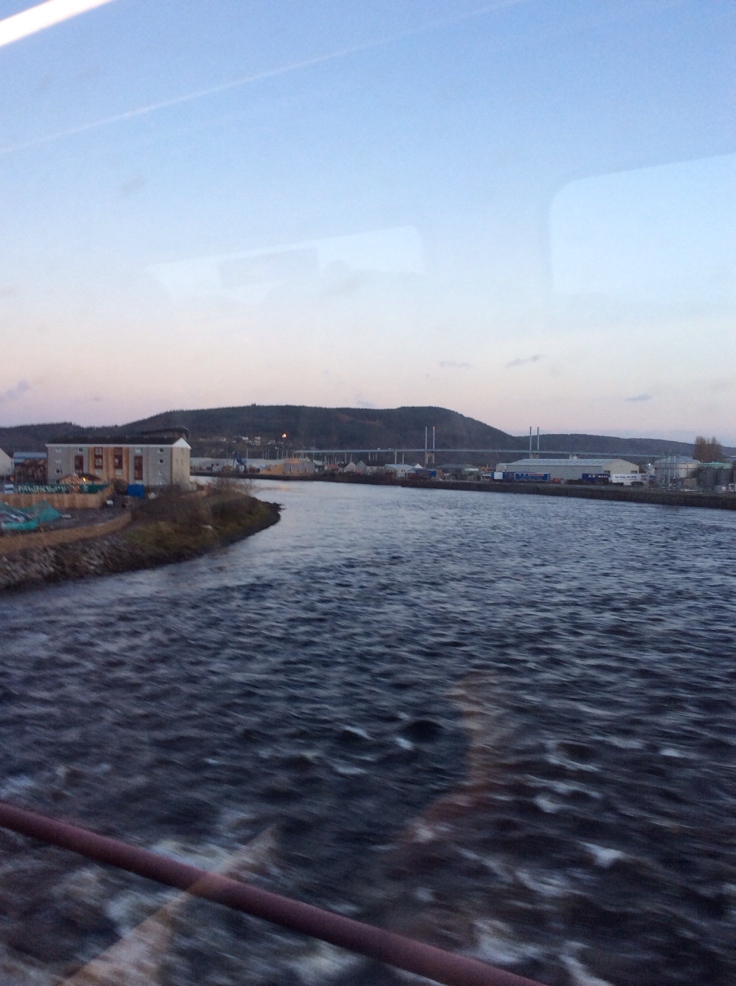
Here are a selection of photos from this morning for you to judge for yourselves:

Standard

To the Highlands

The sleeper arrived early into Inverness which gave me a fifteen minute window to wander around the town centre. The sky was clear but only just getting light, with a few wisps of red cloud sitting on the horizon. It was cold and grey, but the air was crisp. I did feel like I’d stepped off the train into a foreign country; I think that’s partially the effect of the sleeper train. When you’ve slept on a journey it gives the impression that you’ve travelled much further than you actually have.

My brief time in Inverness quickly drew to a close, as I had to head back to the station to get my next train: A service that will carry me across the highlands to Kyle of Lochalsh (feel free to look it up on a map – I had to yesterday) and back again – effectively a cross-country trip from the east coast of Scotland to the west.


Standard

The Caledonian Sleeper

One of the advantages of the ‘All Line Rover’ is that it can also be used to provide you with heavily discounted hotel accommodation – as long as that hotel is a train. This isn’t as dire a situation as it might sound as there are a number of ‘sleeper’ services that operate every evening in the UK. I’d had experience of one of these before, the service that runs overnight from London to Penzance, but the one I decided to try out last night was the ‘Caledonian Sleeper’, the train that travels from London Euston to your Scottish destination of choice. The ‘All Line Rover’ covers your seat on the train, you only have to pay a small supplement if you want an upgrade from a reclining seat to a cabin. I took the upgrade.

The train itself is actually three trains joined together. At some point in the night they separate and the front section ends up in Fort William, the middle in Aberdeen and the rear in Inverness. As you would imagine, ensuring you’re in the right section of the train is somewhat key, but luckily you’re booked by name into your cabin and are checked off a list when you board the train.

So what’s it like? The cabins themselves have been made to have as long a bed as possible – around 6ft. As a result the corridor that runs down the outside of the cabins is narrow-boat in its proportions:
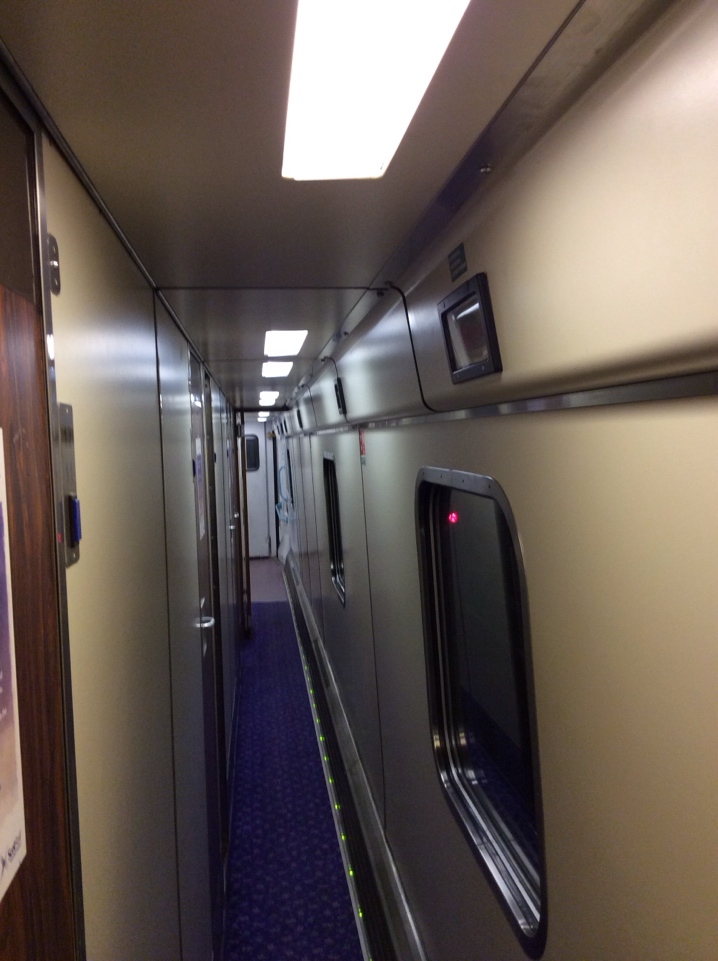
The cabin has two bunks and, if there are two of you, it would be quite a squeeze to move around when you both weren’t in bed. If you’re really daring you can share your confined cabin with another, random, member of the public. I decided against that this time and went for the standard cabin, with no bunk-mate:
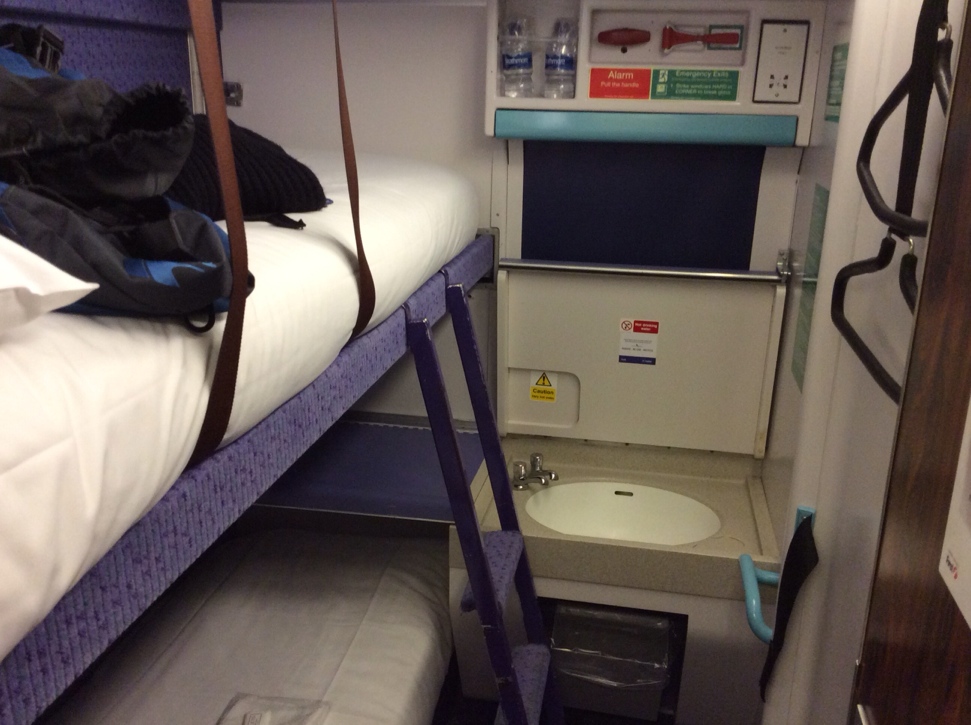
In the cabin you have a small sink, mirror, private window-with-blind, and your own air-conditioning control (this is a big thing and is repeated several times in the information booklet). If you opt for First Class the cabin is essentially the same, but with no top bunk.
One of the residing memories of the previous time I’d been on a sleeper (apart from it being the first time I’d heard the Tom Lehrer song ‘Poisoning Pigeons in the Park’ – if you’ve never herd it, head for the internet) was that it was one of the worst nights sleep I’d ever had. Undaunted, I organised myself in the bunk, turned out the four cabin lights, adjusted my personal air-conditioning control (have I mentioned this already? It’s all the range…), and tried to get to sleep.

To say I slept well would be overstating it, but, after I got used to the movement of the train and the random jolts every time the rest of the train caught up with the locomotive, I didn’t sleep badly. I dreamt mainly about being on a sleeper train, which doesn’t say much for my imagination but I think you can understand why.
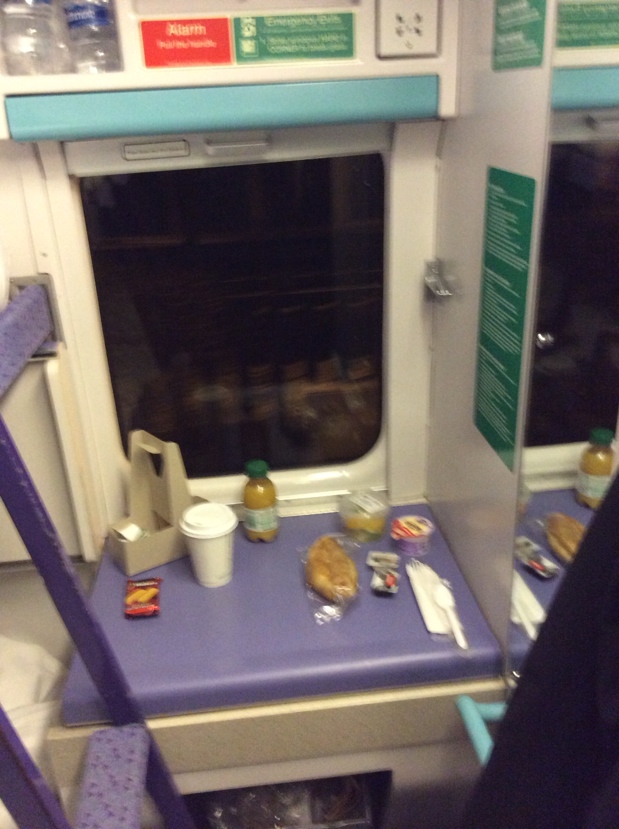
I’d requested my wake-up call / breakfast for 7:15 and it arrived dot-on time. Breakfast was served with the early-morning Scottish countryside zipping past my window:
Having finished breakfast I packed my assorted things back together into the rucksack and left the sleeper train behind, over six-hundred miles away from where I had embarked it. The weather was cold, the wind strong and, for a southerner, there was a significant amount of snow on the ground.

There’s something awfully nostalgic, even romantic, about a sleeper train. It harks back to a simpler time, before budget flights and the Information Age, when it would be a thing of wonder that you could go to bed in London and wake up in Inverness. Sure, it isn’t the quickest, most-efficient way of getting from a to b, but where else can you be lulled to sleep by the gentle movements of a slightly-weary train, gliding through the dark, still, British countryside?
It’s certainly an experience I won’t soon forget.

 

Standard

Carol Singers

While I was waiting for my next train to board in London Euston station, a group of carol singers had set up shop underneath the departure boards. They were raising money for Marie Curie cancer care and had a number of volunteers wandering around the waiting travellers with buckets. They’d attracted quite a large audience which was, unfortunately, prone to a very rapid thinning-out every time a train to Birmingham New Street was announced. 

After about twenty minutes a man who’d been waiting with everyone else approached the singers and asked if they wanted a cup of tea or coffee. When getting the answer ‘yes’ he then proceeded to the nearest coffee shop in the station and brought drinks for all the carol singers to order – be it tea, coffee, cappuccino or hot chocolate. Bearing in mind there were over thirty carol singers, and this was station-priced coffee, he must have shelled out almost a hundred pounds on drinks for them. Having completed buying the round of drinks he wished them all ‘Merry Christmas’ and headed off to his train.


Standard